




The Mechanism of Action

A systemic approach to hair growth
Hair growth is a complex biological process that cannot be controlled in isolation at the hair surface. Hair follicle activity is regulated by hormonal signals, nutrient availability, blood circulation, inflammatory processes, and the hair cycle. In women from around age 38 or during hormonal transitions, these factors change measurably.
For this reason, ShinyHair is not based on individual active ingredients or isolated products, but on a systemic mechanism of action that specifically targets the biological prerequisites for hair growth.


Why hair loss occurs
The key focus is inside the body. Hormonal changes, oxidative stress, and reduced nutrient availability can cause hair follicles to reduce their growth activity or enter the telogen phase (resting phase) prematurely. A purely topical treatment can only have limited influence on these processes.
How our products work

Phase 1: Internal stimulation of hair follicles
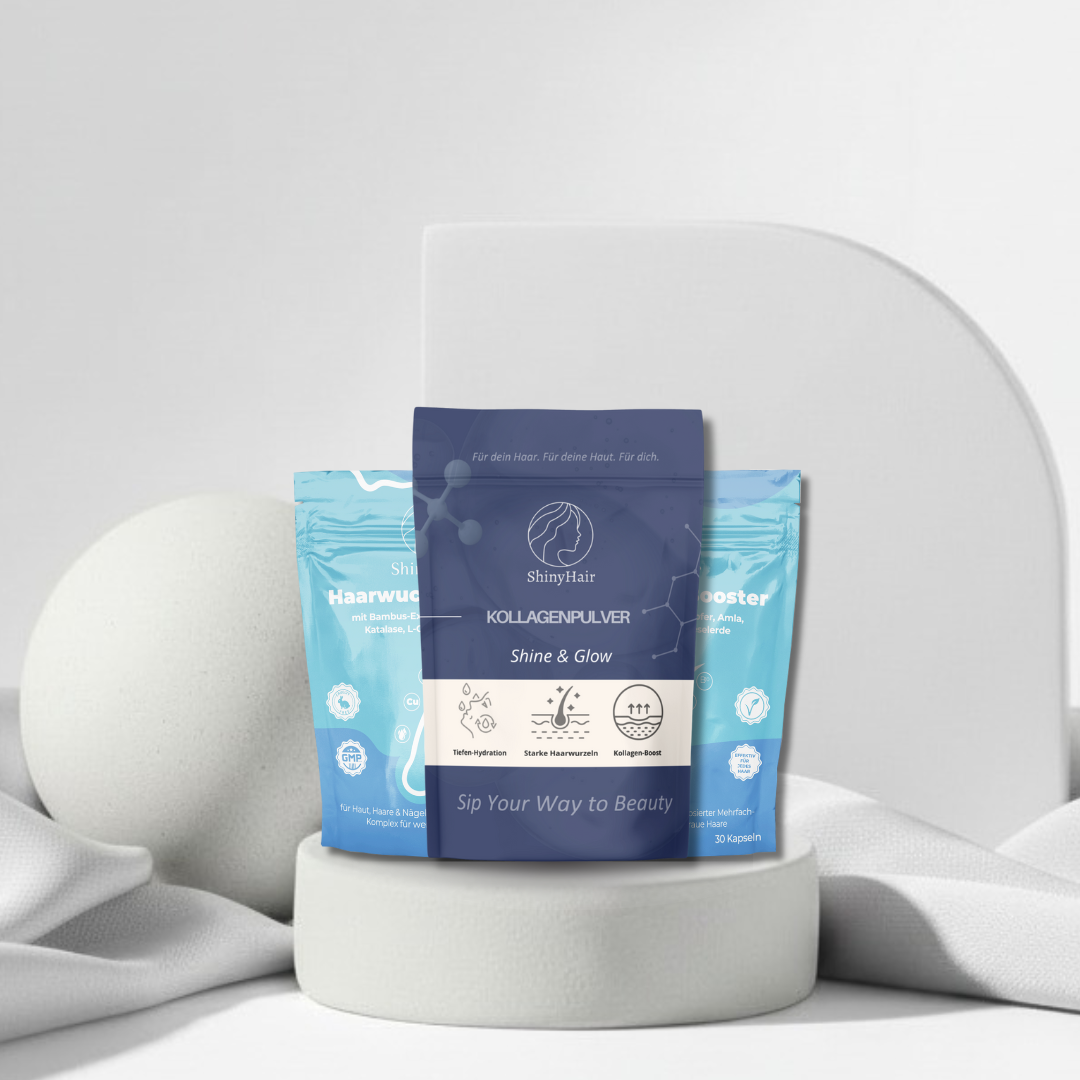
The hair growth booster was developed to support the hair root at a systemic level. It delivers targeted nutrients and bioactive substances involved in processes relevant to hair growth:
- Amino acids (e.g., L-Cysteine) as a prerequisite for keratin biosynthesis
- Copper to support melanin synthesis and hair structure
- Silicon from bamboo extract to stabilize the hair fiber
- Amla and catalase to reduce oxidative stress and protect hair follicles

Phase 2: Topical support for scalp and hair structure
Building on internal nourishment, targeted external application follows.
The topical products are formulated to support biological processes at the scalp level and structurally strengthen regrowing hair.
- GrowthElixir™ with rosemary oil to promote microcirculation
- Shampoo and Conditioner to maintain a physiological scalp balance
- Hair mask with Aloe Vera, rosemary oil, six cold-pressed oils, and wheat protein to strengthen the hair fiber, reduce breakage, and improve elasticity
Experience real changes in just 3-6 months
Continuous internal nourishment creates the conditions to keep hair follicles in the growth phase (anagen) longer and support the formation of stronger hair.
 02
03
02
03
Month 1-2
Hair appears denser, stronger, and healthier. Split ends and breakage decrease, hair is easier to style, and shows new shine.
Month 3-4
Hair appears denser, stronger, and healthier. Split ends and breakage decrease, hair is easier to style, and shows new shine.
Month 5-6
The hair growth booster reaches full effect: visibly fuller, stronger hair, reduced hair loss, and a stable hair structure for long-term healthy growth.
The ShinyHair Hair System
Only when hair follicles are systemically well-nourished can topical care products fully unfold their effect. ShinyHair is therefore not a random collection of individual products, but a coordinated hair system that addresses both causes and supports hair growth holistically—from the root to the tip.

Before

After
The most frequently asked questions about our products
1. Does it help with thinning or falling hair?
2. Can men also use ShinyHair products?
3. Do I need to use the entire routine to see results?
4. Are your products vegan and cruelty-free?
5. Are ShinyHair products safe for colored hair?
6. How long until I see results?
Three active ingredients with proven effects
Our formulas contain highly effective ingredients whose effects on hair growth and hair structure are scientifically proven:
- Bamboo extract provides bioavailable silicon, supporting keratin formation and hair stability (see Jugdaohsingh et al., 2007).
- Amla (Phyllanthus emblica) contains antioxidant polyphenols that can stimulate cell activity in hair follicles (see Kumar et al., 2018).
- Copper acts as an essential trace element in enzymatic scalp processes, promoting pigmentation and collagen cross-linking (see Prohaska & Broderius, 2004).
Sources:
Trueb, R. M. (2001). The value of scalp care in the management of hair loss. Dermatologic Clinics, 19(2), 313–319. https://doi.org/10.1016/S0733-8635(05)70217-2, Jugdaohsingh, R. et al. (2007). Silicon and Bone Health. Journal of Nutrition, 137(2), 552–557. Kumar, N. et al. (2018). Hair Growth Promotion by Phyllanthus emblica Extract. Journal of Ethnopharmacology, 219, 219–226. Prohaska, J.R., & Broderius, M. (2004). Copper deficiency alters collagen and elastin cross-linking in mice. Journal of Nutrition, 134(9), 1953–1957.